From this link you can see all the chairs. They are finally all ready!
https://www.dropbox.com/gallery/77966008/1/Tilatekstiiliprojekti?h=f1cc38
Wednesday, May 9, 2012

Hannas complete chair and analysis
Because the blog isn't allowing me to upload any photos I am using dropbox instead. So from the next two links you can see my final chair.
https://www.dropbox.com/s/jyqfp6em2to55mi/IMG_0236_25.jpg
https://www.dropbox.com/s/lg7tl5xqdwd4udy/IMG_0234_25.jpg
https://www.dropbox.com/s/jyqfp6em2to55mi/IMG_0236_25.jpg
https://www.dropbox.com/s/lg7tl5xqdwd4udy/IMG_0234_25.jpg
Tuesday, May 8, 2012


Valpus analysis
So I write also my analysis.
METHOD
I have coverd (or upholstered) my chair with wool.
Techniques I used to make materials, were
And in a making materials I had to think how much is enough.
I screwed screws throught knitted socks. Before it I put littlebit erikeeper to the socks, I think, it doesn't break down then so easily
We all had same kind of techniques and colours in our chairs, so combination be based only on same startingpoint and theme, but also on the same techniques and colours.
USE
I think, my and also all chairs in our interculturalchairsgroup are very usable.
I added padding to the seat so it's little bit softener, so it's also little bit more comfortable to sit on the chair.
Because wool isn't very durable material, I matted seat-cover-material, so I think now it's more durable.
AESTHETICS and EXPRESSIVITY
I think, all chairs of our group express very well our idea and startingpoint. They are reminding to national costumes and chairs resemble each other closely, but still they are individual (if chair can be ü).
Maybe other people don't see the interculturalism so easily because Latvian and Finnish national costumes resemble each other closely. However, someboby could notice Sulkava colors in my chair, but rythm on stripes is strange, because it comes from Latvia. And some Latvian could know pattern in backrest and rythm on seat, but colors are maybe strange. It's interculturality.
And I think, our chairs are beautiful, both alone and on group.
We all had same kind of techniques and colours in our chairs, so combination be based only on same startingpoint and theme, but also on the same techniques and colours.
CONTEXT
(I feel, I can't write anymore in English so I continue in Finnish ü )
Mielestäni tuolit sopivat hyvin kasvien keskelle kirjastoaulaan. Nyt aula on aivan tyhjä ja autio, mutta tuolit tuovat tilaan sopivasti eloa ja paikan pysähtyä.
Ajattelen, että meidän kansallispuku-interkulttuurisuus- teemamme sopii hyvin sekä tuohon tilaan, että tähän aikaan. Oletan, että kansallispuvut koetaan usein ehkä hiukan jämähtäneinä ja tunkkaisina vaatteina, mutta tuolimme tuovat niiden hengen tähän päivään. Ne ovat perinnettä ja perinteistä kulttuuria henkivät, mutta silti nykyaikaa ja erittäin tätä päivää edustavia tuoleja.
Voisin kuvitella, että tuoleilla istuvia, tai niitä ihastelevia (ü), voisi kiinnostaa, miten ja mihinkä perustuen tuoliryhmä on rakentunut.
Ja mie jätin tuoliini ne valkoset sukat, vaikka aluksi mietin, ettei ne sopis siihen.
Mutta kun kysyin muilta, heiän mielestä ne sukat oli hyvät, eikä väriero pistäny silmään, ni jätin ne sitte tuolille jalkaan. Kyllä ne varmaan sitoo sen tuolin paremmin yheksi osaksi valkosukkien kokonaisuutta.
after all,
I can say, this was good project and it has given to me quite much.
At the beginning I thought this is quite difficult project, because we had five different persons in our group and I thought it's quite hard to get good combination of chairs. But now I'm ready to admit, I'm surprised how good chair-combination we have made.
But I think we used quite much time to plan our chairs, colours and techinques during the process.
At the beginning I was scared also because of the language, because I really haven't to used english, but I have survived, come off. (But I had days I understand nothing and can't speak, but anyway ü)
Thanks! Kiitos!
METHOD
I have coverd (or upholstered) my chair with wool.
Techniques I used to make materials, were
- knitting (with knittingmachine) (socks and seat-material)
- matting (in washingmachine) (seat-material)
- felting (backrest)
- and weaving with pirta (backrest)
And in a making materials I had to think how much is enough.
I screwed screws throught knitted socks. Before it I put littlebit erikeeper to the socks, I think, it doesn't break down then so easily
We all had same kind of techniques and colours in our chairs, so combination be based only on same startingpoint and theme, but also on the same techniques and colours.
USE
I think, my and also all chairs in our interculturalchairsgroup are very usable.
I added padding to the seat so it's little bit softener, so it's also little bit more comfortable to sit on the chair.
Because wool isn't very durable material, I matted seat-cover-material, so I think now it's more durable.
AESTHETICS and EXPRESSIVITY
I think, all chairs of our group express very well our idea and startingpoint. They are reminding to national costumes and chairs resemble each other closely, but still they are individual (if chair can be ü).
Maybe other people don't see the interculturalism so easily because Latvian and Finnish national costumes resemble each other closely. However, someboby could notice Sulkava colors in my chair, but rythm on stripes is strange, because it comes from Latvia. And some Latvian could know pattern in backrest and rythm on seat, but colors are maybe strange. It's interculturality.
And I think, our chairs are beautiful, both alone and on group.
We all had same kind of techniques and colours in our chairs, so combination be based only on same startingpoint and theme, but also on the same techniques and colours.
CONTEXT
(I feel, I can't write anymore in English so I continue in Finnish ü )
Mielestäni tuolit sopivat hyvin kasvien keskelle kirjastoaulaan. Nyt aula on aivan tyhjä ja autio, mutta tuolit tuovat tilaan sopivasti eloa ja paikan pysähtyä.
Ajattelen, että meidän kansallispuku-interkulttuurisuus- teemamme sopii hyvin sekä tuohon tilaan, että tähän aikaan. Oletan, että kansallispuvut koetaan usein ehkä hiukan jämähtäneinä ja tunkkaisina vaatteina, mutta tuolimme tuovat niiden hengen tähän päivään. Ne ovat perinnettä ja perinteistä kulttuuria henkivät, mutta silti nykyaikaa ja erittäin tätä päivää edustavia tuoleja.
Voisin kuvitella, että tuoleilla istuvia, tai niitä ihastelevia (ü), voisi kiinnostaa, miten ja mihinkä perustuen tuoliryhmä on rakentunut.
Ja mie jätin tuoliini ne valkoset sukat, vaikka aluksi mietin, ettei ne sopis siihen.
Mutta kun kysyin muilta, heiän mielestä ne sukat oli hyvät, eikä väriero pistäny silmään, ni jätin ne sitte tuolille jalkaan. Kyllä ne varmaan sitoo sen tuolin paremmin yheksi osaksi valkosukkien kokonaisuutta.
after all,
I can say, this was good project and it has given to me quite much.
At the beginning I thought this is quite difficult project, because we had five different persons in our group and I thought it's quite hard to get good combination of chairs. But now I'm ready to admit, I'm surprised how good chair-combination we have made.
But I think we used quite much time to plan our chairs, colours and techinques during the process.
At the beginning I was scared also because of the language, because I really haven't to used english, but I have survived, come off. (But I had days I understand nothing and can't speak, but anyway ü)
Thanks! Kiitos!
Saturday, May 5, 2012
Dainas analysis
Method
Sitting part:
For the base of sitting part I made fabric from wool yarns on the knitting machine. I made several decorative stripes – the central is made by hand knitting from blue wool yarn and natural linen thread, which I used to make the diamonds from Finnish national costume. The narrow stripes are made in rigid handle weaving technique, like in ancient times. I used the same materials – green and blue wool yarn, and linen thread.
Back part:
The base of the back part is felted from natural white wool. I made again the same Finnish diamonds by embroidery from red woolen yarn. In the center I embroidered a traditional Latvian sign – the grass snake. This symbol stands for wisdom.
Back part support pillars:
The pillars are surrounded with a machine knitted wool fabric from thin natural white thread.
Usage
My chair is very functional and I think it’s really nice
to sit on it, not only because its cosy but it’s also good looking and
decorative – I think these properties gives people a good inner feeling, when
sitting on an extraordinary chair. I think
it will be also quite long lasting, especially the back part, because it’s made
from strong materials. The sitting part is well cushioned and comfortable, but if
often used, it my get worn out in a while. In general, wool fabrics are quite resistant.
Aesthetics and Expressiveness
I think my chair inherits both of these values. I really
like how the composition of my chair turned out in the end with the changes I made.
The sitting and the back part work really well together, because of the common
shapes I used in both parts and the suiting colours. My chair looks well together
with all the chairs from our set and still somehow it stands out with some different
details as all the other chairs. I think we managed well to make or ideas about
intercultural chairs alive and unite two similar and in the same time different
cultures in one. Each chair talks for itself.
Context
We planned to put the chairs near the cafeteria at a
corner around the table. Next to the table there is a plant on at the wool
there are some nice graphic pictures, which remind me of ancient Latvian
fisherman. I think the presence of our intercultural chairs would make the
corner look kind of romantic place where one can go to sit, relax and gather
their thoughts.
I think in these modern, technology times with way too much
information around people need some relaxation space. Although our chairs are
made inspiring from national costumes, they look suitable for nowadays environment,
kind of modern, but with an ancient touch.
And I also want to thank the other group members for nice
collaboration. It probably wasn’t easy to work this project in a foreign
language especially when it’s necessary to use so many terms, but we managed
well. I think we learned a lot from each other!
Kiitos – paldies! :)
Some design changes


To save time, I made some changes for my chair's design. First I decided to make the pattern of the back part more simple. I embroidered 3 diamonds which are found in the Finnish national costume and in the center diamond I put a Latvian traditional sign - grass snake. This sign symbolizes wisdom. Originally all Latvian traditional signs are construed basing on 90 degree angle, but the diamond has a 60 degree angle. I really like how these two shapes work together.
Some other changes were made for the sitting part. I decided not to make those small diamonds at the sides and leave only one line - reasons for this are that actually the chair is not wide enough and to make everything as I planned in the beginning would take too much time.

Here you can see the results. I think the two parts look really nice together because of the common shapes and colors and in general my chair looks good between our other chairs. They really make a great set.
I still haven't finished the whole parts, so I drew the 2 missing lines on Paint to show how my chair is going to look in the end.
Thursday, May 3, 2012
Analysis of Ilze's chair
Hello!
I made analysis and summary about my chair and this project.
- METHOD:
- Sitting part: I made crochet slip stitch stripes from wool yarns in three colours inspired by Finnish traditional costume.
- I made filling in two layers for seat to be more softer and removed old fastenings, attached fabric with stapler. I rempved all spare fabric from corners and sewed a decorative fabric seam.

- Backseat: I used non coloured white wool for felting fabric for backseat. I attached it to chair with stapler. I made decorative tablet woven belt from wool yarns in same colours I used for chair's sitting part fabric.

- Legs: Felted wool ''boots'' and tablet woven belts - same as for backseat. Originaly I wanted to make these woolen ''boots'' longer, but while puting chair together it seemed better to wrinkle them and made smaller. I think they go together with backseat very well.

- PRACTICAL USAGE: I think my chair is ergonomic and it is suitable for using. It is practical and decorative in same time. When I was making my design I tried to think more about how I can make it decorative and practical in the same time and not overdecorate it. In my oponion I succeeded.
- AESTHETICS and EXPRESSIVITY: As our theme and main idea was to make chair combo in very beginning we were discussing about coulours and designs and how they will go together. Idea was to show how Latvian and Finnish patterns and colours from traditional costumes, which are very valuable for our cultures, can go together and stress out similarities and differences. So that at first we selected same kind yarns in various colours which can refear to both Latvian and Finnish traditional costume and wool we can use. From selected ones I chose only three colours and during making design I tried to keep up with that. I wanted my chair to express interculturality in a very simple way. I chose not to overdecorate it and use only few techniques which also will be refeared to ancient traditional ones. I think my chair express our ideas in a good way.
- CONTEXT: I think that was great oportunity for us, exchange students to make chairs which we will leave for University. They are like a part of us and symbol for our studies here. That would be great to come back and find our chairs and remember all nice times we had here. And maybe for the people from other counrties who are coming to visit University our chairs might seem like a very interesting interiour decoration. Learning more about Finnish culture by the time I spend here gave me opportunity to compare and get to know both cultures more deeper. I think for our chair combo there is not neccesary place where they belong. They are intercultural and that means that they can work as a symbols for that sepatately and together. Personaly I would like to see them in some public place where everyone can see them and use them as well. In my opinion the best one is in the first floor near the cafeteria. There is beautyful big picture which reminds me pictures from Latvian fairytale book. That would suit to our chairs I think.
In general I am pleast with my and all chairs we made. Our collaboration together were very succesful. I think we had great time during shis course and we all reached our aims.
Thank you very much!
Ilze.
Wednesday, April 25, 2012
Analysis
We should made analysis about our chairs with Papanek's the function complex (http://moodle.uef.fi/file.php/88/TEHTAEVAE2012.pdf).
Functions are
Can everybody edit these texts if we continue with this text?
Functions are
- METHOD (tools, techniques, materials)
- USE (how chair works as chair, and is it durable)
- AESTHETICS and EXPRESSIVITY (ilmaisevuusü) (combination of colours and forms in wholeness and how the chair shows that we wanted to)
- CONTEXT (how chairs fit to the place, we have planned to set them, and how they fits in this time and cultural context where we live)
Can everybody edit these texts if we continue with this text?
Tuesday, April 24, 2012
Ready?


Maybe it is ready now!
Not just a like my plan, but nearly :)
But I must to think about socks.
They looks so yellow-white, and I think, they don't look good with natural-white backrest.
Could this be better without socks?
Still in process

Knitted seat-fabric after first washingmachine-felting.

Knitted seat-fabric after second washing-machine-felting.
Look at the difference between felted fabric and sample without felting!

The warp-yarns to the backrest-lace..

And chair still in process..
Saturday, April 21, 2012


Saturday, April 14, 2012
Dainas chair plan


So this is my chair plan. For inspiration I used to Traditional skirts - one Latvian and one Finnish. Pattern I created is a combination of both skirt patterns put together.
This I will use for the sitting part. I will knit the red base fabric fro wool on the machine and I thought I could make the lines separately by rigid handle weaving and knitting. The light squares I will do by embroidery from light colored linen yarn. The separate lines will be longer and hang nicely towards ground. I hope you can understand my idea from the illustration.
The base fabric for back-part will be felted and decorated with embroidery. I found this symbol in an ancient Latvian belt and again I will somehow unite it with the Finnish squares.
The base fabric for back-part will be felted and decorated with embroidery. I found this symbol in an ancient Latvian belt and again I will somehow unite it with the Finnish squares.


Friday, April 13, 2012

Wednesday, April 4, 2012
Interculturality- what is it?
I noticed we have only spoken about interculturalism, but not writing about it, or only the name "Intercultural Chairs".
So I add this quote from "Education GUIDELINES- UNESCO Guidelines on Intercultural Education"
(I didn't write it with own words because it is so difficult in english ü)
"Interculturality is a dynamic concept and refers to evolving relations between
cultural groups. It has been defi ned as “the existence and equitable
interaction of diverse cultures and the possibility of generating shared
cultural expressions through dialogue and mutual respect.19” Interculturality
presupposes multiculturalism and results from ‘intercultural’ exchange and
dialogue on the local, regional, national or international level." (page 17)
So I add this quote from "Education GUIDELINES- UNESCO Guidelines on Intercultural Education"
(I didn't write it with own words because it is so difficult in english ü)
"Interculturality is a dynamic concept and refers to evolving relations between
cultural groups. It has been defi ned as “the existence and equitable
interaction of diverse cultures and the possibility of generating shared
cultural expressions through dialogue and mutual respect.19” Interculturality
presupposes multiculturalism and results from ‘intercultural’ exchange and
dialogue on the local, regional, national or international level." (page 17)
Tuesday, April 3, 2012
Sulkava-coloured chair
I have tried to find right colours and rythms, so I have made some samples.

At last presentation I had the first one (blue one) sample with me, but I didn't like the colours of yarns. I think, it isn't a good color-combination, because of colours are so dark.Many people said on feedback, that Sulkava-colours (red) are better than Keski-Suomi-colours (blue), so I began to work with them.
And I think, this colour-combination works together (=toimii yhteen= is good), but anyway, the second one sample (in the middle) was quite bland/nondescript (mitäänsanomaton).
Then I tried to change the rhythm of it (little bit more light green, little bit less darker red), but then I added small darkgrey stripe there. I think the last one sample is the best of my samples.
I have also asked for other people what do they like about rhythms and colors, and they have also said the last one bit of the last one sample is the best.

So, I think, I'll take Sulkava- colors and rythm from Lībiešu brunči. Dundagas brunču audums, vilna
What do you think, is it ok?

At last presentation I had the first one (blue one) sample with me, but I didn't like the colours of yarns. I think, it isn't a good color-combination, because of colours are so dark.Many people said on feedback, that Sulkava-colours (red) are better than Keski-Suomi-colours (blue), so I began to work with them.
And I think, this colour-combination works together (=toimii yhteen= is good), but anyway, the second one sample (in the middle) was quite bland/nondescript (mitäänsanomaton).
Then I tried to change the rhythm of it (little bit more light green, little bit less darker red), but then I added small darkgrey stripe there. I think the last one sample is the best of my samples.
I have also asked for other people what do they like about rhythms and colors, and they have also said the last one bit of the last one sample is the best.

So, I think, I'll take Sulkava- colors and rythm from Lībiešu brunči. Dundagas brunču audums, vilna
What do you think, is it ok?
Friday, March 30, 2012


Wednesday, March 28, 2012
Ilze's chair
For my chair design I decided to combine Finnish - Lapland's traditional costume COLOURS:
Blue
Red
White
(instead of yellow)

Sitting part of chair I decided to make in crochet technique.
For pattern I choose three colour combinated regular pattern from Latvia's traditional costume's skirt (3rd from right):

Back part of chair I will felt from white wool, do decorative crochet lace in white around circumference and decorate with tablet woven belt (because it is ancient Latvian and Finnish belt weaving technique and in traditional costumes there usually are some parts done in this technique) in three coulour - white, blue, red, combination.
During the process I decided to decorate chair legs with four felted ''boots'' with decorative tablet woven belts, similar to one I made for back part of chair. Somehow this idea about felted boots reminded me russian traditional winter footwear valenki. As our both, Latvian and Finnish historys are connected with Russia I think this idea would fit for this project. Here: http://kids-gazette.blogspot.com/2011/02/vuti-krievu-valenki-latviesu-gaume.html I found some nice information about contemporary valenki trends which are connected with Latvian design.
My inspiration for boots is this picture from here:


Monday, March 26, 2012
My chair
Backrest:
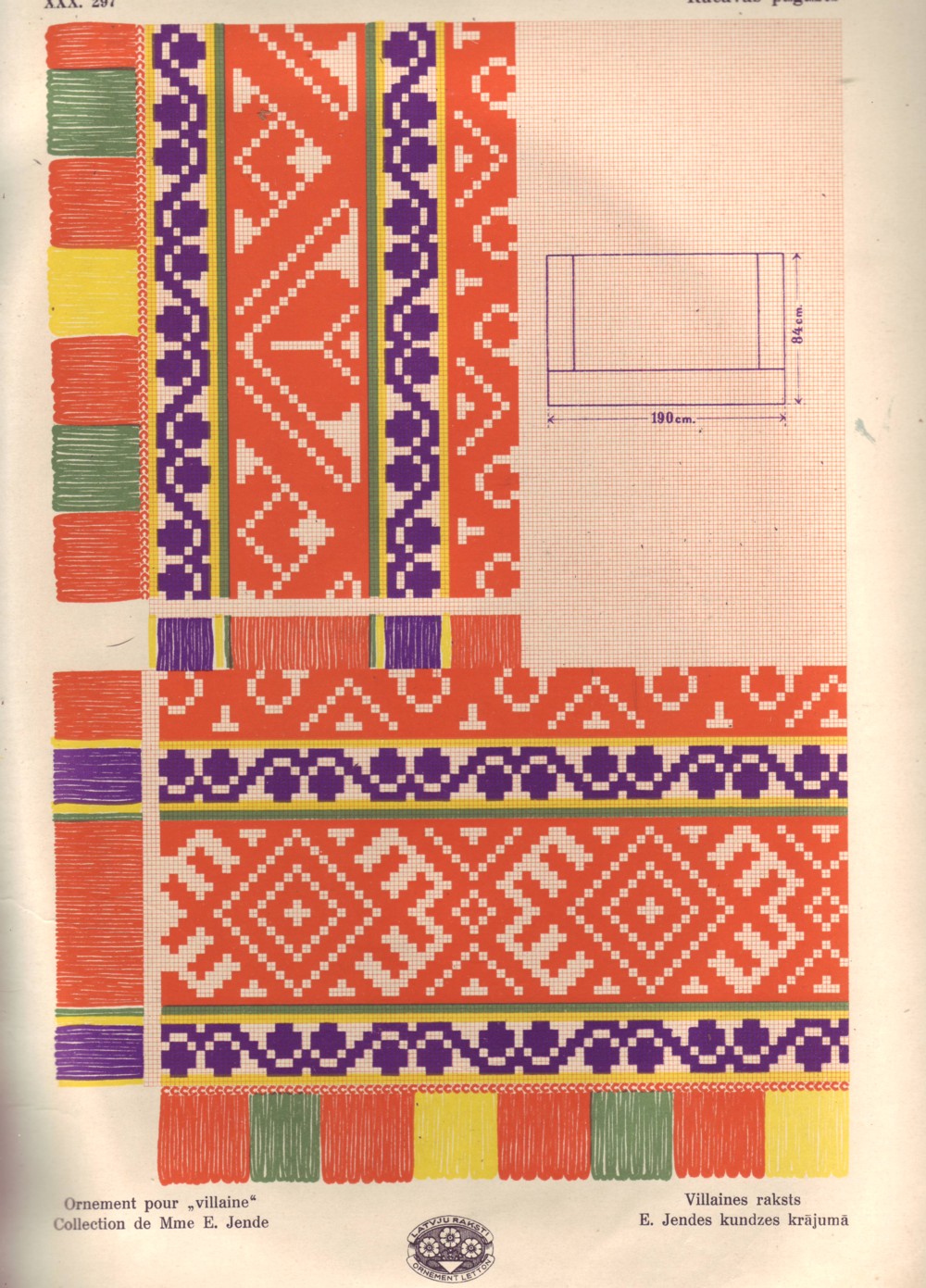
Felted backround (could it be dark blue or white) and woven pirtanauha (ribbon?):
http://zagarins.net/Latvjuraksti/Krekluraksti/XXX_297_Rucava.JPG
Seat:
Woven or knitted+felted. Colours and rythm:
http://kotitarvemetsuri.files.wordpress.com/2012/02/karkausikkunallaweb.jpg
http://www.amatnieciba.lv/piedavajums_tautasterpi.htm
http://adielanmekot.blogspot.com/2011/06/kansallispuku-nyt.html
Legs:
Knitted. Blue or off-white (=naturalwhite) or red


Sulkava
Lībiešu brunči. Dundagas brunču audums, vilna
Keski-Suomi


Felted backround (could it be dark blue or white) and woven pirtanauha (ribbon?):
http://zagarins.net/Latvjuraksti/Krekluraksti/XXX_297_Rucava.JPG
Seat:
Woven or knitted+felted. Colours and rythm:
http://kotitarvemetsuri.files.wordpress.com/2012/02/karkausikkunallaweb.jpg
http://www.amatnieciba.lv/piedavajums_tautasterpi.htm
http://adielanmekot.blogspot.com/2011/06/kansallispuku-nyt.html
Legs:
Knitted. Blue or off-white (=naturalwhite) or red


Sulkava
Lībiešu brunči. Dundagas brunču audums, vilna
Keski-Suomi


Suomalaisia kansallispukuja- finnish national costumes
Here http://www.kansallispuvut.fi/ you can find photos about Finnish national costumes.
I haven't found any web-site with good photos.
I haven't found any web-site with good photos.
Last week idea picture
 Here are some ideas for a chair in my project. The chair's legs could be knitted tubes and seat woven fabric with colors of the Finnish national costume.
The backrest could be covered with cloth embroidered with needle. Patterns could be drawn from details of the other national costumes or parts thereof.
Sunday, March 25, 2012


Tuesday, March 20, 2012

Monday, March 19, 2012
Some more Latvian national costumes and patterns

In these pages you can find many more pictures of Latvian folk costumes and different patterns witch were made by embroidery, weaving, knitting.
National costume center "Sena klēts"
Different patterns from book "Latvju raksti"

And here are some of my first chair designs sketches. The picture in the right is my idea how would a chair look like when wearing Latvian folk costume. The two chairs on left are intercultural chairs: color combinations from Finland and vertical/horizontal pattern compositions from Latvia.
Wednesday, March 14, 2012
Chair-sketches
I have sat down and thought these chairs today (like everybody of us ü).
But I thought could it be easier to form a coherent whole of chairs, if they were little bit simpler. I have also thought could chairs be not humans, but planned with ideas from national costumes.
I have tried to sketch few pictures with the aid of idea photos (without interculturalism).
 |
| From book: Lehtinen & Sihvo. 2005. Rahwaan puku. Folk Costume. s.82 |
 |
| Photo: www.samiduodji.com/15 |
I hope, you understand what I have tried to say :)
Latvian traditional costume
Inspiration:
Here you can see many nice pictures about Latvian traditional costume variations:
skirt fabrics, socks, woolen shawls etc.:
http://www.amatnieciba.lv/piedavajums_tautasterpi.htm
And some samples from traditional skirt fabrics here:

Here you can see many nice pictures about Latvian traditional costume variations:
skirt fabrics, socks, woolen shawls etc.:
http://www.amatnieciba.lv/piedavajums_tautasterpi.htm
And some samples from traditional skirt fabrics here:

Monday, March 12, 2012
At the first meeting..
At the beginning we decided to change one meeting time from April. So we are meeting 3rd of April at 12:15 instead of 4th. And the classroom in A225.
We had two main ideas about what we are going to do withing the course. The first one was about mixing Finnish and Latvian patterns and colors so that we would have made Finnish patterns with Latvian colors and vice versa. I promised to bring some books that I have for this idea to next meeting.
The second idea was about mixing national costumes and making the chairs into humans. I think that this one was more popular than the first one and we had a huge amount of ideas.
At the evening me and Anitta were still machine knitting when Tarja came and we asked about this course and how we should pursue. We told her that second idea and she was thrilled! :) She just loved our idea and promised to bring some material of which we can make samples. And we also took some linen yarns already. There were quite bright colors and we thought that linen would be good considering that our work is all about traditions.
-Hanna
We had two main ideas about what we are going to do withing the course. The first one was about mixing Finnish and Latvian patterns and colors so that we would have made Finnish patterns with Latvian colors and vice versa. I promised to bring some books that I have for this idea to next meeting.
The second idea was about mixing national costumes and making the chairs into humans. I think that this one was more popular than the first one and we had a huge amount of ideas.
At the evening me and Anitta were still machine knitting when Tarja came and we asked about this course and how we should pursue. We told her that second idea and she was thrilled! :) She just loved our idea and promised to bring some material of which we can make samples. And we also took some linen yarns already. There were quite bright colors and we thought that linen would be good considering that our work is all about traditions.
-Hanna
Thursday, March 8, 2012




Subscribe to:
Posts (Atom)